
AI and Web3 have been the two narratives most reliably able to attract capital attention in crypto over the past few years. A project only needs to slap on labels like "AI infrastructure," "decentralized compute," "model verification," and "on-chain incentives," and it can often draw substantial attention in a short period of time.
DN — DeepNode's native token — is one of the representative projects in this "AI + Web3" narrative.
Unlike new tokens with no real material behind them beyond a slogan, DeepNode does have publicly disclosed funding information, technical documentation, exchange listing history, a token contract, and tokenomics data. It isn't the kind of anonymous, no-substance project that's impossible to verify at a glance.
On the other hand, DN also experienced a sharp crash following its TGE (token generation event), accompanied by controversy involving a liquidity partner. For beginners, this is exactly where research on DN matters most: you can't ignore the risk just because there's funding, documentation, and an AI narrative — but you also can't write the project off entirely just because it crashed once.
The more mature approach is to put the fundamentals and the risk events on the same table and analyze them together.
This article covers:
- What DN/DeepNode actually is
- What problem its PoWR mechanism is trying to solve
- Whether the team, funding, and technical documentation can be verified
- What sell-pressure risks exist in DN's tokenomics
- What risk events occurred after the TGE
- What mainnet progress means for the token's value
- How to size your position if buying DN on a platform like HiBT
- What key signals to keep tracking after buying
This is not investment advice. DN is an early-stage, highly volatile crypto asset that has already experienced a major price drawdown — beginners need to budget for risk before participating.
1. What Exactly Is DN/DeepNode? What Problem in the AI Industry Is It Trying to Solve?
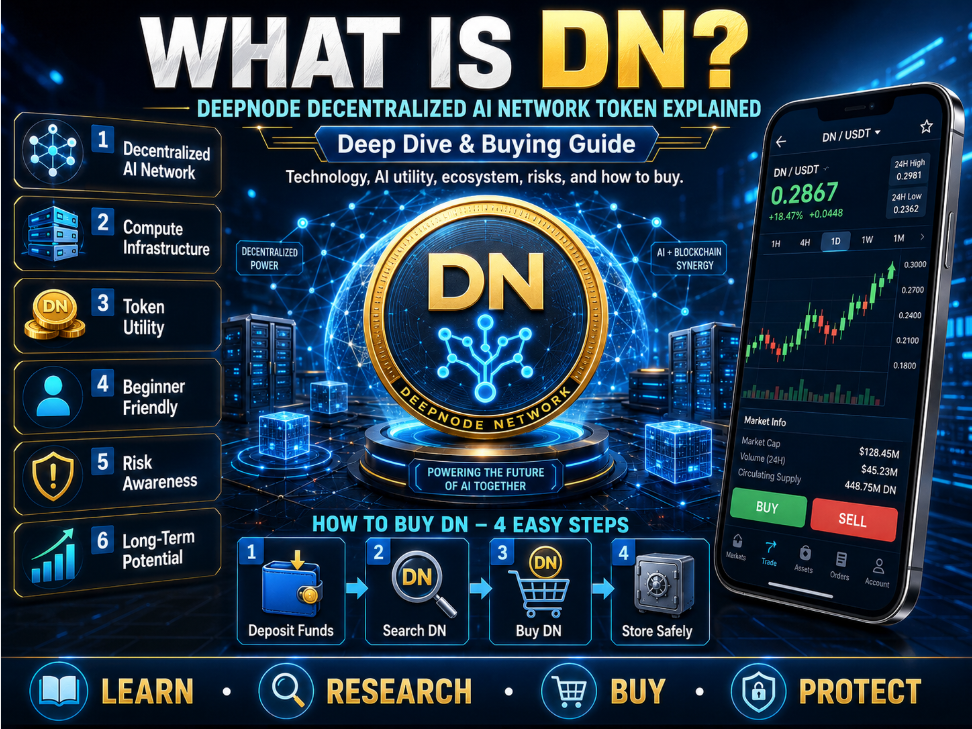
DeepNode positions itself as a decentralized AI infrastructure network. In simple terms, it's trying to connect AI models, compute resources, validator nodes, developers, and enterprise users into a single on-chain incentive system, so that contributors can earn DN token rewards through the network.
The traditional AI industry has several well-known problems:
- High-performance compute is concentrated in the hands of a few cloud providers
- Training and inference for large models are expensive
- It's hard for developers to access reliable compute affordably
- There's no unified incentive structure connecting model contributors, data contributors, and node operators
- AI model quality is difficult to evaluate transparently in an open market
- Users often don't know whether a model's output is actually useful
What DeepNode is trying to build isn't "another chatbot" — it's a decentralized AI infrastructure layer that lets different participants form market-based collaboration around AI models and compute.
What Do Developers, Miners, and Validators Each Do?
The DeepNode ecosystem can roughly be divided into a few categories of participants.
Developers. They can build, deploy, or call AI models, integrating applications into the DeepNode network. In theory, if the network is mature enough, developers can access AI capability in a more open way, rather than relying entirely on centralized cloud providers.
Miners or node operators. "Miners" here doesn't necessarily mean traditional Bitcoin-style mining — it refers to people who provide compute resources, model services, or node operation capability. They participate in the network by providing valid resources and earn rewards based on their contribution.
Validators. Validators verify model outputs, task results, and node performance. A core part of DeepNode's narrative is that rewards shouldn't go purely to whoever provides compute — they should go to whoever provides genuinely useful AI output.
Enterprises or end users. These are parties that might need to call AI models for data analysis, automated diagnostics, fraud detection, risk control, image recognition, or industry-specific model services. If the network can provide reliable service, they pay fees, and the network distributes that value back to contributors.
For beginners, a simple way to think about DeepNode:
It's a decentralized application marketplace for AI models and AI compute contributions, where genuinely useful models, nodes, and validators get rewarded in DN.
How Does PoWR Differ from Traditional PoW and PoS?
One of DeepNode's central technical claims is PoWR, usually explained as "Proof-of-Work-Relevance" — essentially, proof that the work being rewarded is relevant or actually useful.
Traditional PoW, like Bitcoin's proof of work, focuses on using compute to solve cryptographic puzzles in order to secure the network. Miners spend electricity and hardware resources, and whoever completes valid work earns the block reward.
Traditional PoS, like Ethereum's proof of stake, focuses on staking tokens and participating in validation. Validators take on economic responsibility by locking up assets, and the system maintains network security through reward and penalty mechanisms.
PoWR is aiming at something different. It's not simply rewarding "who has more compute," and it's not simply rewarding "who staked more" — it's trying to reward "whose AI contribution is more genuinely useful."
In one line: PoW measures compute work; PoS measures staked responsibility; PoWR tries to measure the relevance and real usefulness of an AI contribution.
This sounds compelling, because an AI network really shouldn't be rewarding meaningless computation. What actually matters is whether a model solves problems, whether its output is accurate, and whether the results actually get used.
But there's a key risk here too: "usefulness" is much harder to measure objectively than a hash computation.
Bitcoin's PoW has an unambiguous verification result — whether a hash meets the difficulty target is immediately checkable. But whether an AI model's output is "useful" usually depends on task type, evaluation criteria, datasets, user feedback, model bias, and the verification mechanism itself. If that evaluation system isn't well designed, it can open the door to gamed tasks, inflated scores, fake contributions, or validator collusion.
So PoWR is both DeepNode's most interesting innovation and the risk point most in need of long-term verification.
Why Build on Base Instead of a Custom Blockchain?
DeepNode chose to build on the Base ecosystem rather than building its own blockchain from scratch, and there are practical reasons behind that.
Building a custom chain sounds more ambitious, but it's far more costly: you need to build a validator network, maintain base-layer security, attract wallet support, browser tools, and developer tooling, solve cross-chain liquidity, and absorb the chain's own stability risk.
Base, as an Ethereum Layer 2, already has a relatively mature EVM environment, wallet support, developer tooling, a block explorer, and liquidity access points. For an early-stage AI infrastructure project like DeepNode, choosing a mature L2 lets the team focus more energy on the AI network itself, rather than building a base-layer chain from zero.
This choice has real benefits: a lower development barrier, a more familiar wallet experience for users, contracts that are easier to inspect, easier access to ecosystem liquidity, and not having to carry the entire base-layer security narrative alone.
But it also has limitations: the project is affected by Base's own ecosystem development, transaction fees and network experience are still shaped by the L2 environment, future cross-chain deployments could create multiple asset versions that confuse users, and the project doesn't have full control over the underlying chain.
So choosing Base is more of a pragmatic decision than an outright advantage.
A One-Line Way to Understand DeepNode
For someone with zero technical background, here's a simple way to think about it:
DeepNode wants to build a decentralized marketplace for AI models and AI compute contributions, rewarding genuinely useful models, nodes, and validators with DN.
Or even more simply: it wants to move the "AI services marketplace" on-chain, using token incentives to reward valuable AI contributions.
This framing helps you grasp the core idea: DeepNode isn't simply an AI chat tool, and it's not simply a GPU rental platform — it's trying to combine AI-contribution evaluation, resource coordination, and token incentives into one system.
2. Do DeepNode's Team, Funding, and Technical Documentation Hold Up Under Scrutiny?
A basic principle when investing in new tokens: the more transparent the information, the more assessable the risk; the less information available, the smaller the position should be.
Compared to many fully anonymous projects, DeepNode does have considerably more verifiable information — funding announcements, investor names, official documentation, a contract address, market-data platform listings, and an exchange listing history.
But "verifiable" doesn't mean "risk-free." It only means the project didn't appear entirely out of nowhere — it doesn't prove future success.
What Does a $5 Million Raise Tell You?
DeepNode has publicly disclosed completing a $5 million raise across a seed round and a strategic round. Participants reportedly included Blockchain Founders Fund, Side Door Ventures, TBV, IOBC Capital, Fomo Ventures, Nestoris, and others.
This kind of funding information has two points of value for beginners.
First, it shows the project hasn't gone completely unnoticed externally. Institutional participation at least means the project went through some level of due diligence and engagement during fundraising.
Second, it provides a verifiable lead. Investors can check whether these firms genuinely exist, and whether they mention DeepNode on their own website, social media, or portfolio page, or whether there are joint announcements or reposts.
That said, funding information shouldn't be over-interpreted either.
Funding doesn't guarantee project success — plenty of well-funded Web3 projects have still failed. Funding also doesn't guarantee the token price will rise, and it certainly doesn't mean investors will hold forever without selling.
More importantly: funding creates a future unlock problem. When seed-round, strategic-round, team, and advisor allocations eventually release, they can all create sell pressure on the market.
Are the Whitepaper, GitBook, and Contract Address Complete?
Compared to a new token with zero documentation, DeepNode at least has a more complete public information structure: an official website, a whitepaper or project overview document, GitBook technical documentation, a tokenomics page, a smart contract address, exchange project pages, market-data platform listings, and community channels.
This is a positive signal for beginners — more complete materials make it easier for investors to verify the project's claims.
But you still need to keep asking: is the documentation just marketing copy, or does it contain real technical detail? Has the contract been audited by a third party? Is GitHub public? Has the mainnet genuinely launched? Is the model verification mechanism testable? Does PoWR have a reproducible technical explanation? Can partnerships be independently confirmed? Is the data self-reported by the project, or third-party verified?
Genuine due diligence isn't "I saw documentation, so I feel reassured" — it's "I'm using the documentation to ask more verification questions."
How Should You Read Information About Validators and Partners?
DeepNode's early materials mention several validators, partners, or infrastructure-related participants — names like WildSageLabs, Rizzo/DNA, and Gateway.FM.
The value of this kind of information is that it provides external cross-verification clues.
Beginners can check: does the partner's own website mention DeepNode; has the partner's X/Twitter ever reposted related announcements; is the relationship a technical collaboration, an investment, node support, or just a general marketing partnership; is there specific deliverable content; are there concrete timelines; or does the claim only appear in DeepNode's own materials?
If a partnership only ever shows up in the project's own press release, and the partner has never publicly confirmed it, it shouldn't be treated as a strong endorsement. Conversely, if both sides have made announcements, and you can later see actual technical integration or node operation data, credibility is much higher.
What's the Difference Between "Documented but Still Early" and "Completely Unverifiable"?
This is a distinction beginners need to learn to make.
A completely unverifiable project usually has these traits: no real website, no team information, no documentation, no contract transparency, no disclosed funding source, no code, no roadmap, and nothing but community hype and price predictions.
DeepNode isn't that kind of project — it has materials, funding, documentation, and trading history.
But it's still an early-stage project, because: its mainnet mechanisms still need long-term validation; whether PoWR actually works still needs supporting data; a large share of tokens haven't been released yet; it experienced a major price drawdown after TGE; price remains heavily influenced by AI sentiment and overall market mood; and most of its technical metrics still come from the project itself or secondary-platform descriptions.
So the more accurate risk classification for DeepNode is:
A high-risk AI infrastructure token with relatively complete materials, but still in the early validation stage.
That's somewhat lower risk than a completely unverifiable project, but nowhere close to BTC, ETH, or leading protocols that have already been validated across multiple market cycles.
3. DN Tokenomics: Breaking Down Total Supply, Allocation, and the Unlock Schedule
Researching DN can't stop at the AI narrative — you also have to look at the tokenomics. Even a great project can see its price suppressed long-term if token release pressure is too large, the circulating float too small, or sell pressure too strong.
Total Supply and Current Circulating Supply
DN's total supply is 100 million tokens (100,000,000 DN). Current circulating supply is roughly 22.5 million tokens, putting circulation at around 22.5%.
What does that mean? It means roughly three-quarters or more of the total supply hasn't yet entered full circulation. Over time, these tokens will gradually enter the market through ecosystem incentives, team unlocks, investor unlocks, liquidity arrangements, and treasury releases.
For investors, what matters most isn't "what's the price right now" — it's how many more tokens will be unlocked in the future.
If the project develops well, newly unlocked tokens can fund ecosystem building, node rewards, developer incentives, and user growth. If demand falls short, those unlocks can instead turn into sustained sell pressure.
So DN's long-term price depends not just on the AI narrative, but on whether genuine network demand can absorb the tokens still to be released.
What Does "Emissions + Grants" Making Up 50% Mean?
In DN's token allocation, Emissions and Grants together make up a large share — roughly 50%. This category is typically used for: node rewards, model-contribution rewards, developer incentives, ecosystem subsidies, user growth, and grant funding.
This is a reasonable allocation for a decentralized AI network, since the network genuinely needs long-term incentives for contributors. But it also creates a problem:
If rewards are released faster than real demand grows, the token can stay under sustained pressure.
A simple example: if the network releases a large amount of DN every month to nodes, model contributors, and ecosystem projects, but those participants don't hold the tokens long-term — instead selling immediately for stablecoins or operating costs — the market needs continuous buying pressure just to absorb that.
So Emissions + Grants isn't inherently bullish or bearish — it all depends on whether it actually translates into network growth.
Things to check: are active nodes increasing; is model usage volume increasing; are enterprise users genuinely paying; are developers continuing to build; are ecosystem projects retaining users; are the rewards actually reaching genuine contributors; and can the token price withstand the release pressure?
How Should You Read the 15% Team/Advisor Lockup Design?
DN's team and advisor allocation is roughly 15%. Public unlock data shows this isn't released immediately at TGE — it has a longer lockup followed by a linear release schedule.
From an industry perspective, long lockups for team tokens are a fairly common design, and generally align better with long-term incentives than an immediate TGE release.
The positive side: the team can't dump a large amount in the short term, the team's interests stay tied to the project's long-term development, the market can anticipate the unlock timeline in advance, and it avoids team tokens directly hitting the market right at TGE.
But it's still not risk-free, because the lockup eventually ends. Once team, seed-round, and strategic-round allocations enter their release period, if project revenue, users, and trading demand haven't grown in step, the market may still worry about unlock-driven sell pressure.
So what beginners should actually do is mark key unlock dates on a calendar — not just observe that "nothing's unlocked yet."
How Should You Understand the Fee-Burn Mechanism?
DN's materials mention a fee-burn or deflationary mechanism. In theory, if there's genuine usage on the network and users pay fees, with a portion of DN being burned, circulating supply would decline, creating deflationary pressure.
This mechanism is logically appealing: more network usage means more fees; more burning means less supply; if demand grows faster than new issuance, price could benefit; and token holders would have more reason to focus on real usage.
But the key issue is: burning only matters if it's backed by genuine network usage.
If the mainnet isn't fully mature yet, model usage volume is limited, enterprise users are scarce, and fee revenue is low, then the burn mechanism's actual impact on price is very limited.
So when evaluating DN, don't just check "does it have a burn mechanism" — check: is the burn contract verifiable; is the burn amount publicly disclosed; is the burn frequency consistent; does the burn actually come from real fee revenue; and how large is the burn relative to daily trading volume and future unlock volume?
A burn narrative without real usage behind it tends to stay purely conceptual.
4. A Fact You Can't Avoid: What Happened After the TGE?
The issue DeepNode can't avoid is its price performance after the TGE.
Public market data and reporting show that DN's TGE on January 9, 2026, with simultaneous listings on multiple exchanges, was followed by a sharp drop in a short period of time. Some secondary-market commentary suggests DN fell rapidly from its early high, with a decline approaching or exceeding 80%.
This wasn't minor volatility — it was a major risk event.
Why Can Listing on Multiple Exchanges Simultaneously Actually Increase Volatility?
A lot of beginners assume that a token listing simultaneously on Gate, KuCoin, MEXC, Bitget, Binance Alpha, and similar platforms must be a strong bullish signal.
In reality, simultaneous multi-platform listings don't necessarily mean stable price action — they can actually create a more complicated price-discovery process.
Reasons include: different starting liquidity across platforms; early holders being able to sell across multiple venues at once; airdrop recipients potentially cashing out quickly; market-maker strategies that may not be stable; retail buyers chasing the rally and then panic-selling; price discrepancies between exchanges creating arbitrage opportunities; and genuine buy/sell pressure being highly uncertain in the opening hours.
The TGE stage is essentially the market's first attempt at pricing a project, and that process can be genuinely chaotic. A price spike followed by a sharp crash isn't unusual.
How Should You Understand the "Liquidity Partner Selling Off Collateral" Controversy?
Regarding DN's post-listing crash, some market reporting and community discussion mention a "liquidity partner selling off collateral" or similar claims.
If accurate, this would be a fairly serious matter, since it involves listing liquidity arrangements, partner accountability, token management, and market trust. But without an independent audit, legal finding, or complete official review, an article shouldn't present this as a fully confirmed fact.
A more accurate framing would be:
"After DN's listing, market controversy emerged around a liquidity partner, with some secondary sources alleging it was related to collateral handling. Investors should look at official statements from the project, exchange announcements, and subsequent developments — rather than relying solely on community rumors."
This presents the risk honestly without overstating what's actually confirmed.
How Should Beginners Interpret "Crashed Right After Listing"?
Crashing right after listing doesn't necessarily mean a project is going to zero, but it does point to real problems in the early market structure.
Possible causes include: an excessively high initial valuation; too small a circulating float; listing expectations getting front-run; heavy sell pressure from airdrop or early-allocation recipients; insufficient market-making depth; arbitrage-driven sell pressure from simultaneous multi-exchange listings; insufficient communication from the project; and capital being highly sensitive to shifts in AI-narrative sentiment.
For beginners, the most important takeaway is: an asset that's already experienced a major crash isn't suitable for a large "conviction bet."
Even if you believe in DeepNode's long-term direction, you should acknowledge that the market already expressed serious uncertainty through its pricing. Whether that recovers depends on project delivery, mainnet data, trading volume, and restored community trust — not just on a bounce in the candlestick chart.
How Should You Read Current Price and Volume After the Crash?
After the TGE crash, DN went through a period of low-level consolidation, and has since seen periodic volatility tied to AI-narrative shifts, broader market rebounds, or recovering volume.
This kind of price action tells you two things.
First, DN still has trading interest. If a new token completely loses trading volume after crashing, the risk is even higher. DN is still tracked across multiple market-data and trading platforms, meaning it hasn't disappeared entirely.
Second, volatility remains very high. A bounce off the lows doesn't mean a trend reversal. Many high-volatility new tokens can rally 50% or 100% in a short period, only to pull back just as quickly.
So when looking at DN's current price action, don't just ask "is it up" — check: is volume sustained; is buying pressure stable; is there genuine new mainnet progress; is there real network data backing it up; is an unlock approaching; or is this just a short-term narrative rotation?
5. What's the Status of DeepNode's Mainnet Launch? What Does That Mean for DN's Value?
For DN, mainnet launch matters more than a short-term exchange listing. An exchange listing only provides a trading venue — the mainnet is what determines whether the token actually enters real use.
Did the Originally Planned Mainnet Launch Happen?
DeepNode's early materials mentioned a mainnet launch plan and post-TGE network phases. By the time this article is read, it's worth re-checking official announcements, GitBook, the X account, and community updates to confirm whether the mainnet has officially launched, been delayed, or whether what's live is only a testnet or partial functionality.
A few concepts worth distinguishing here: testnet availability, mainnet launch, node registration being open, models being callable, validator rewards starting, fee burning starting, and enterprise use cases actually going live.
Many projects will say "the mainnet phase has begun," when in reality only part of the functionality is live. Investors need to check whether the functionality is genuinely usable — not just read the headline.
How Would DN Generate Real Demand Once the Mainnet Is Live?
If DeepNode's mainnet is genuinely operational, demand for DN could come from a few directions:
Model usage fees. Users or developers calling AI models may need to pay fees in DN or denominated in DN.
Node staking. Node operators may need to stake DN to gain eligibility, build reputation, or take on accountability for penalties.
Validator rewards. Validators participating in model-output verification earn DN rewards.
Governance. DN may be used for network governance, parameter adjustments, or voting on ecosystem grants.
Burn mechanism. If a portion of fees flows into the burn process, supply could decrease.
Whether these mechanisms can actually support the token's value comes down to real usage volume. If tokens are just moving between exchanges, without the network having actual model calls, nodes performing real tasks, or validators doing real work, then demand for the token will end up relying mostly on speculation.
How Should You Read Claims Like "Two Nodes Verifying One Model, 98% Success Rate"?
DeepNode's marketing materials may include figures like "multi-node verification," "high success rate," or "high reliability." For this kind of technical data, beginners should apply two layers of judgment.
First, if the data comes from the project's own self-reported disclosure, it's worth treating as a reference point. The project knows its own network best, and early-stage data is usually published by the project itself.
Second, without third-party verification, it shouldn't be treated as fully objective fact. Genuinely persuasive data ideally comes from a block explorer, an independent audit, a third-party monitoring platform, a partner's test report, or a reproducible developer test.
When evaluating technical metrics, keep asking: how large was the test sample; how is "success" defined; was this on testnet or mainnet; are failure cases disclosed; is there independent verification; does it cover real enterprise tasks; and can it be cross-checked against on-chain data?
If you want to compare against an asset with a more established mechanism that's already been validated through a full market cycle, to help calibrate position sizing, HiBT's analysis on whether now's a good time to buy RPL offers a useful framework. RPL's evaluation focuses more on protocol role, market cycle, and long-term infrastructure demand — a sharp contrast to an early-stage AI network token like DN.
6. A Risk Checklist Beginners Must Think Through Before Investing in DN
DN has real material behind it, but it also carries clear risks. For beginners, the first question isn't "should I buy it" — it's "can I actually tolerate the risk."
The AI + Web3 Narrative Can Outpace Real Usage
The AI narrative is strong, but crypto markets frequently price in future expectations well in advance.
Many AI tokens rise in price not necessarily because real network revenue is growing, but possibly because of: broad AI-sector sector rotation, concentrated influencer discussion, exchange promotional events, a low circulating float on a new token, rising market risk appetite, or speculative capital chasing the next hot theme.
This means that buying DN may not get you exposure to an already-mature AI infrastructure cash flow — it may get you an early-stage narrative option instead.
A narrative option has real upside potential, but also real risk of going to zero.
Future Unlocks Remain a Long-Term Sell-Pressure Variable
DN's current circulating supply of roughly 22.5 million, against a total supply of 100 million, means a large amount of tokens are still set to be released over time.
Potential sources of sell pressure include: Emissions, Grants, the team and advisors, the seed round, the strategic round, the treasury, and liquidity-related allocations.
If the project develops well, unlocked tokens can be absorbed by real demand. If network usage is insufficient, unlocks can put sustained pressure on price.
Beginners absolutely need to learn to track the unlock calendar — particularly around when team, seed-round, and strategic-round allocations begin releasing, since the market typically reacts in advance.
Discount Technical Metrics That Lack Third-Party Verification
The hardest thing to verify in any AI network is model output quality and the verification mechanism itself.
The project can claim high success rates, fast node growth, and good model quality — but investors should ask: who verified these metrics; is there a public dashboard; are there on-chain records; are there real customers; is there an independent audit; are failure cases disclosed; and is there long-term data?
The absence of third-party verification doesn't necessarily mean the project is being dishonest, but it does mean your investment judgment needs to be more conservative.
An Asset That's Already Crashed 88% Demands a Lot Psychologically
A lot of beginners assume they can handle volatility, but in practice panic at a 20% drop, average down at -50%, and feel hopeless at -80%.
Given that DN has already experienced a major price drawdown, it's clearly not a low-volatility asset. Before buying, you need to ask yourself: what will I do if it drops 30% after I buy; can I stay calm at -50%; will I cut losses if the mainnet is delayed; will I reduce my position as an unlock approaches; will I keep holding if volume declines; and will I exit if the project's communication becomes opaque?
If you don't have answers to these questions, a large position isn't appropriate.
7. A Practical Guide to Buying DN on HiBT: Five Steps
If you've finished your research and decided to try buying DN through HiBT, follow the five steps below. Whether DN/USDT is actually available, which network is supported, and what the fees are should always be confirmed against HiBT's own page and announcements.
Step 1: Register on HiBT and Complete KYC
After visiting HiBT's website or app, register with your email or phone number. After completing registration, immediately set up: a login password, email or phone verification, Google Authenticator, a funds password, and an anti-phishing code.
Then complete KYC verification, which usually requires an ID document, facial verification, or address information. Review time depends on the platform's risk controls and the quality of submitted materials — sometimes it's quick, sometimes it takes longer.
For beginners, KYC isn't an optional step — it affects fiat channels, withdrawal limits, and account security.
Suggested screenshots: registration page, KYC verification page, security center page, funds password setup page.
Step 2: Deposit USDT or USDC
Before buying DN/USDT, you'll need to prepare USDT. Two common funding methods exist.
Fiat channel. Suits beginners with no existing crypto. It's straightforward, but may involve fees, exchange-rate spreads, channel restrictions, and review time.
On-chain transfer. Suits users who already hold USDT or USDC. It's flexible, but you must select the correct network.
When depositing, check: that the deposit currency is correct, that the deposit network matches the sending network, that the address was copied in full, whether a Tag or Memo is required, whether a small test transfer arrives, whether enough confirmations have passed, and whether on-chain fees are reasonable.
If you're not confident about network selection, don't transfer a large amount right away — testing small first is the most basic safety habit for beginners.
Suggested screenshots: deposit entry point, USDT network selection, deposit address page, deposit confirmation record.
Step 3: Search for the DN/USDT Pair
Go to HiBT's spot trading section and search "DN."
Pay special attention to similarly named or similarly abbreviated tokens here. There may be assets on the market called DNCoin, DNCOM, or other tokens using the "DN" abbreviation. Don't rely on the symbol alone — verify: that the project name is DeepNode, that the official website matches, that the contract address matches, that the network matches the exchange announcement, that it's a spot trading pair, whether there's a leverage or futures entry point, and whether any risk warnings are shown.
Beginners should prioritize spot trading and avoid jumping into futures when first getting familiar with DN. DN already carries significant volatility on its own — adding leverage on top amplifies that risk further.
Suggested screenshots: DN search results page, DN/USDT spot trading page, project info page, risk warning page.
Step 4: Use Limit Orders to Control Slippage
DN is a smaller-cap, higher-volatility token. Even if 24-hour volume looks decent, order book depth can thin out quickly during sharp price swings.
Market orders suit small, fast fills, but can incur significant slippage. Limit orders let you control your entry price, but may not fill immediately.
A more disciplined approach: check order book depth first, don't chase a rapid rally, use limit orders and buy in batches, keep individual order sizes modest, test with a small amount first, and avoid impulsive buying right around announcements, an approaching unlock, or sharp market volatility.
Low-cap AI tokens are especially vulnerable to emotional buying — jumping in after seeing it on a "top gainers" list usually means you've already taken on elevated risk.
Suggested screenshots: market order input, limit order input, order book depth, trade history.
Step 5: Write a Stop-Loss Plan Before Buying
For an asset like DN, you shouldn't buy first and think about risk afterward. The correct order is: define your risk first, then decide how much to buy.
Write down at least three things before buying.
First, your maximum position size. Use only a small portion of your total capital as exploratory exposure — the earlier-stage the information, the higher the volatility, and the more controversy involved, the smaller the position should be.
Second, your stop-loss conditions. These can be price-based or fundamentals-based — for example, breaking below a certain cost basis, a clear drop in trading volume, mainnet delays, the official channel going quiet for a long time, or an approaching unlock.
Third, your profit-taking approach. If the price rallies sharply in the short term, don't assume it will keep going up forever — consider taking profit in batches, recovering your principal first, then leaving a small remaining position to watch how things develop long-term.
Position management isn't about capping your upside — it's about making sure one bad call doesn't wipe out your account.
8. What Should You Track After Buying? Three Signals Worth Watching Continuously
After buying DN, you can't just watch the candlestick chart. What really determines long-term value is whether the project can move from "AI narrative" to "actual AI network usage."
Mainnet Launch and Ecosystem Partnership Progress
DN holders should keep tracking: whether the mainnet has officially launched, whether node registration is open, whether validators are genuinely operating, whether model calls are generating real fees, whether fee burning has started, whether there are real partnerships in vertical use cases like medical diagnostics, fraud detection, or risk control, whether partners independently confirm these relationships, and whether technical documentation continues to be updated.
Tracking channels include: the official website, GitBook documentation, the official X account, Discord or Telegram, exchange announcements, market-data platform project pages, block explorers, and third-party research platforms.
If a project only publishes marketing posters without any verifiable delivery, you should lower your confidence in holding the position.
The Unlock Calendar
One of DN's key future risks is its unlock schedule.
You need to track: team and advisor unlock timing, seed-round release timing, strategic-round release timing, the pace of Emissions releases, who Grants are being distributed to, how the Treasury is being used, and whether large wallets are transferring to exchanges.
An unlock isn't automatically bearish, but the market usually prices it in ahead of time — especially when the unlock size is large relative to the circulating market cap, which can cause noticeable volatility.
A more disciplined approach is to review your position at least one to two weeks before each major unlock date, rather than reacting only after the price has already moved.
Trading Volume and Holder Concentration
If DN's price rises without a corresponding increase in volume, it may just be a low-liquidity rally. If volume suddenly spikes without the price rising, it may indicate large holders are distributing. If wallet concentration is high, the price is more vulnerable to being moved by a small number of addresses. If large wallets are frequently transferring to exchanges, treat that as a warning sign of potential sell pressure.
After buying, it's worth continuously checking: 24-hour trading volume, 7-day and 30-day volume trends, order book depth, top-10 address concentration, large transfers, exchange wallet balance changes, the number of on-chain holders, and whether versions on Base, BSC, or other chains are consistent with each other.
For a side-by-side comparison of how a different project handles information transparency and community communication, HiBT's basic introduction to what the IDOL token is offers a useful contrast. Comparing how different projects disclose information makes it easier for beginners to judge which projects are worth observing with a small position, and which are worth tracking long-term.
9. FAQ
1. Are DN, DNCoin, and DNCOM the same project?
Not necessarily. DN is just a ticker symbol, not a unique identity — there may be multiple tokens on the market using DN or similar abbreviations. Before buying, verify: that the full project name is DeepNode, that the website is DeepNode's official site, that the contract address matches, that exchange announcements match, that the network matches, and that market-data platform links match.
Don't place an order just because you see "DN/USDT" — the same symbol can belong to a completely different project.
2. Did DeepNode's TGE crash affect users' ability to withdraw or trade?
Based on secondary-market information, what happened after DN's TGE was sharp price-level volatility and liquidity-related controversy — not an event where all platforms uniformly halted trading or blocked withdrawals.
But for any specific platform, the exchange's own announcement is the authoritative source. Beginners should check: whether trading is currently normal, whether deposits are open, whether withdrawals are open, whether there's a maintenance notice, whether there's been a contract migration, whether there are regional restrictions, and whether any unusual risk warnings have been issued.
3. What fees apply to trading DN on HiBT?
Generally: spot trading fees, deposit network fees, withdrawal network fees, the bid-ask spread, and slippage costs. Actual rates should be confirmed on HiBT's own page. For a high-volatility asset like DN, slippage is sometimes more worth paying attention to than the trading fee itself — particularly for large market orders, which can see the fill price diverge significantly from the expected price if order book depth is insufficient.
4. Does DN currently face any regional trading restrictions?
Some exchange project pages have noted restrictions for users in Lithuania or related regions. The scope of restrictions can vary by platform, so investors should refer to their own platform's KYC region rules, terms of service, and project announcements.
If your region has restrictions on crypto trading, AI tokens, Web3 assets, or specific platform services, confirm compliance first rather than trying to work around platform rules.
5. Is DN suitable for long-term holding?
Whether DN suits long-term holding depends on whether DeepNode can actually deliver on real-world usage of a decentralized AI network.
The preconditions for a positive long-term outlook include: a stably running mainnet, growing model usage volume, active nodes and validators, genuine enterprise or developer usage, a functioning fee-burn mechanism, unlock pressure being absorbed by demand, continued communication from the team, and price no longer being entirely dependent on short-term narrative.
If these conditions haven't materialized, DN is better thought of as a high-risk narrative asset rather than a stable long-term holding.
6. How much DN should a beginner buy?
There's no universal answer, but the principle holds: only use money you can afford to lose, start with a small exploratory position, don't go all-in, don't borrow to buy, and don't use high leverage.
If you find yourself anxious every day after buying, that's a sign your position is too large. For an early-stage AI + Web3 project like this, staying able to observe calmly matters more than going all-in at once.
10. Risk Disclosure and Disclaimer
This article is intended for crypto education and risk-awareness purposes only. It does not constitute investment advice, financial advice, or any recommendation to buy or sell.
DN is an early-stage AI + Web3 narrative token with extremely high price volatility, and it has already experienced a significant post-TGE price drawdown and market controversy. Before participating, investors should fully recognize the risk of capital loss — in the worst case, losses could be substantial, potentially down to zero.
Information sources for this article fall into three categories. The first is primary sources, including DeepNode's official GitBook, whitepaper, website, contract address, official social accounts, and block explorers. The second is independently verifiable secondary sources, including funding announcements, exchange project pages, market-data platforms, ICO databases, and third-party research pages. The third is the project's own self-disclosed information or community discussion — covering things like network success rates, model quality, partnership progress, and explanations of the liquidity controversy. This category should be treated with caution and is best supplemented by third-party verification or on-chain data before being relied upon.
Investors should prioritize verifying: the contract address, exchange announcements, circulating supply, the unlock calendar, mainnet launch status, audit reports, large wallet activity, trading depth, and regional restrictions.
If this article's author, the publishing platform, or any related trading platform has a partnership, promotional arrangement, holding, market-making relationship, or other commercial interest connected to the DeepNode project, that should be clearly disclosed at the beginning or end of the article. Transparent disclosure is an important part of building content credibility and meeting EEAT standards.
One final reminder: what's most worth researching about DN isn't "how compelling the AI narrative sounds" — it's whether DeepNode can actually turn that narrative into real network usage. Only if real usage, real fees, real nodes, and real verification data keep growing does DN have a foundation for a meaningful long-term re-rating.