
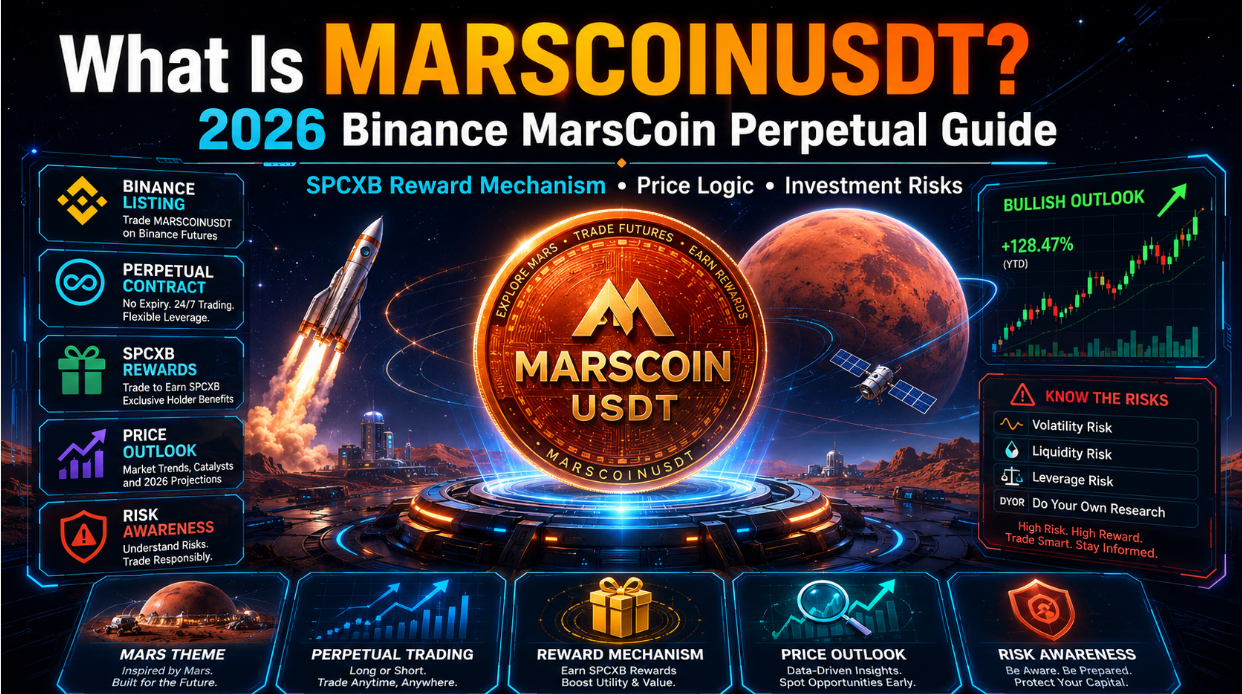
What is MARSCOINUSDT? It is not a new stablecoin, nor is it SpaceX stock itself. To be precise, MARSCOIN is a meme token deployed on BNB Chain, and MARSCOINUSDT is the USDT-margined perpetual contract offered by Binance Futures, allowing traders to go long or short on MarsCoin’s price.
MarsCoin’s defining feature is that it combines meme trading activity with an SPCXB reward mechanism. According to the project’s public mechanics, a portion of transaction taxes is used to acquire SPCXB and distribute it to eligible MarsCoin holders. SPCXB itself carries the narrative of SpaceX tokenized exposure, positioning MarsCoin across multiple market themes simultaneously: BNB Chain memes, Mars culture, SpaceX, and tokenized stocks.
On September 1, 2026, Binance Futures launched the MARSCOINUSDT perpetual contract with up to 20x leverage. This brings MarsCoin greater visibility and more leveraged capital, but it must be made clear:
Binance’s listing of the MARSCOINUSDT perpetual contract does not mean that Binance has listed MarsCoin spot, nor does it imply that Binance endorses the project’s value or price.
Risk Disclosure: This article is for research purposes only—covering project mechanics, contract rules, and market information. It does not constitute investment advice, return guarantees, or trading recommendations. MarsCoin is a high‑volatility meme asset; SPCXB rewards are not fixed income. MARSCOINUSDT is a leveraged contract, and adverse price movements can result in the total loss of margin.
1. What is MARSCOINUSDT? First, Distinguish MarsCoin from the Binance Contract
To understand this project, you must first separate two concepts.
- MARSCOIN is the underlying token.
- MARSCOINUSDT is the USDT‑denominated and ‑settled perpetual contract based on MarsCoin’s price.
The relationship is similar to:
- BTC as the underlying asset;
- BTCUSDT perpetual as the price derivative;
- MARSCOIN as the underlying token;
- MARSCOINUSDT as the perpetual contract for MarsCoin.
Trading MARSCOINUSDT does not mean you receive MarsCoin in your spot account. Contract traders hold long or short positions and bear funding rates, margin requirements, and liquidation risks.
What is MarsCoin?
According to Binance Futures’ announcement, MarsCoin is a meme token built on BNB Chain, with a mechanism that distributes SPCXB rewards to holders.
Thus, MarsCoin can be understood as a combination of three elements:
- BNB Chain meme;
- Mars and SpaceX narrative;
- SPCXB tokenized‑asset reward mechanism.
It is neither a stablecoin, a payment coin, nor an official token issued by SpaceX.
What exactly did Binance list?
Binance Futures listed MARSCOINUSDT perpetual on September 1, 2026, at 09:45 UTC. The initial parameters given in the announcement include:
- USDT settlement;
- 24/7 trading;
- Up to 20x leverage;
- Funding rate settled every 4 hours;
- Minimum trading size of 1 MARSCOIN;
- Minimum notional value of 5 USDT;
- Initial funding rate cap of ±2%.
These parameters may be adjusted based on market risk conditions; always refer to the Binance contract page for current details.
Binance also explicitly stated that there is no necessary link between Futures and Spot listings. A token being listed on Binance Futures does not guarantee a subsequent spot listing.
2. Why Does MarsCoin Carry Meme, Mars, and Stock Narratives All at Once?
MarsCoin attracts attention not just because of the name “Mars.”
Layer 1: Mars Meme Culture
“Mars” naturally evokes:
- Mars exploration;
- Human interstellar migration;
- Elon Musk;
- SpaceX;
- Starship;
- Mars colonization.
These concepts have strong viral potential. Compared to DeFi protocols that require lengthy explanations, a “Mars‑themed meme” can quickly capture attention on social media.
However, narrative association is not commercial affiliation. MarsCoin’s use of Mars, SpaceX, or Elon Musk‑related themes does not mean it is issued, authorized, or backed by SpaceX or Musk.
Layer 2: BNB Chain Meme
MarsCoin is deployed on BNB Chain, so it is also influenced by capital flows within the BNB ecosystem.
If BNB Chain experiences a “meme season,” with rising on‑chain volume, active wallets, and risk capital, MarsCoin may benefit from sector beta.
Conversely, if BNB Chain meme hype fades and capital rotates to Solana, Base, or other ecosystems, MarsCoin may lose liquidity and attention.
Layer 3: SPCXB Rewards
What sets MarsCoin apart from ordinary memes is its holder reward mechanism.
The basic logic:
- Users trade MarsCoin
- → The contract collects transaction taxes
- → Part of the tax is used to acquire SPCXB
- → SPCXB enters the reward distribution mechanism
- → Eligible holders receive rewards
This gives MarsCoin not only a “will the price go up?” story but also a “earn SPCXB by holding” yield narrative.
Layer 4: SpaceX Tokenized‑Asset Narrative
SPCXB carries the narrative of SpaceX tokenized exposure and private‑equity economic exposure. Through SPCXB rewards, MarsCoin indirectly connects to the RWA and tokenized‑stock space.
The narrative chain can be expressed as:
Mars → SpaceX → SPCXB → MarsCoin holder rewards
This makes MarsCoin’s story more complex than ordinary animal memes—and more prone to misconceptions.
3. What is SPCXB? Is It SpaceX Stock?
SPCXB cannot be simplistically described as SpaceX stock in a traditional securities account.
Investors need to distinguish between:
- SpaceX the company;
- SpaceX private equity;
- Tokenized products designed around SpaceX economic exposure;
- The SPCXB token;
- SPCXB rewards distributed by MarsCoin.
SPCXB is an on‑chain asset built around SpaceX economic exposure, but its issuer, underlying support, custody, investor rights, redemption rules, and geographic restrictions may differ from directly holding SpaceX private equity.
For first‑time users, read What is SPCXB and its tokenized stock mechanism before judging the actual value of MarsCoin rewards.
Is SPCXB reward a SpaceX dividend?
No.
The SPCXB received by MarsCoin holders is not a profit distribution made by SpaceX to shareholders, nor should it be described as a cash dividend from SpaceX.
A more accurate statement:
The MarsCoin project distributes SPCXB as a reward asset to eligible holders based on token transaction taxes and reward contract rules.
The reward source is MarsCoin’s own trading and contract mechanics, not SpaceX’s profits, board resolutions, or shareholder dividends.
Why not reward in USDT instead?
If rewards were in USDT, the value would be easier to understand, but it would weaken MarsCoin’s brand story.
Choosing SPCXB creates a narrative closure:
MarsCoin → Mars → SpaceX → Tokenized Stock
This improves market storytelling. However, stronger narrative does not mean lower risk—users bear price volatility in both MarsCoin and SPCXB.
4. How Does MarsCoin’s Transaction Tax Generate SPCXB Rewards?
The MarsCoin project page states that buy/sell transactions incur a percentage tax, and the funds are used for token operations and SPCXB reward distribution. The page currently shows a tax rate of about 2%, but rates, allocation ratios, and contract rules may change. Always verify the latest contract and project details before trading.
Rewards are not created out of thin air.
Their economic source depends on:
- MarsCoin trading volume;
- Tax generated per transaction;
- Efficiency of converting tax into SPCXB;
- Actual distributable balance of the reward contract;
- Eligible holder base.
Why is trading volume so important?
If MarsCoin has consistently high daily volume, even a modest tax rate can accumulate significant reward funds.
If volume drops sharply, tax revenue falls, and the scale of SPCXB that can be purchased and distributed may decline accordingly.
Thus, MarsCoin’s reward capacity is closer to:
Volume‑driven floating rewards
rather than:
Fixed‑rate savings product
Why can a positive feedback loop form?
In a strong market phase, theoretically:
MarsCoin price rises → volume increases → tax revenue increases → SPCXB rewards increase → holding appeal rises → more capital pays attention to MarsCoin
This is a Trading Volume Flywheel.
Why can a reverse cycle also occur?
When the market weakens:
Price falls → volume drops → tax revenue decreases → SPCXB rewards decline → holding appeal weakens → users continue selling
Therefore, the reward mechanism does not eliminate meme asset price risk—it may even accelerate negative sentiment when volume shrinks.
5. How Are MarsCoin Rewards Calculated on Binance Alpha?
Reward paths for MarsCoin in personal wallets and Binance Alpha 2.0 are not identical.
For Binance Wallet holders
According to Binance’s public statement, Binance Wallet addresses that meet Flap distribution conditions will continue to receive rewards automatically via on‑chain rules.
Eligibility depends on:
- Holding the correct token in the wallet;
- Meeting the project’s position requirements;
- Not being excluded (e.g., liquidity pools, contract addresses);
- The reward contract functioning properly;
- The wallet address meeting relevant rules.
For Binance Alpha 2.0 holders
Tokens in Alpha 2.0 are recorded by the platform environment. On‑chain rewards first go to the Binance Alpha Treasury, then the platform distributes them to eligible users according to rules.
On August 24, 2026, Binance Alpha updated its Stock Meme holding reward rules. According to Binance Alpha’s new rules, starting September 2026:
- Daily random snapshots are used to count holdings;
- Holding more than 10,000 MarsCoin on a single day qualifies as valid for that day;
- Monthly valid holdings = sum of valid daily holdings across the month;
- User rewards are proportional to their valid holdings relative to total eligible holdings;
- Rewards for the previous month are distributed at the beginning of the next month;
- MarsCoin rewards are credited in SPCXB to eligible users’ spot accounts.
The first batch under the new rules is expected to be distributed in early October.
Note that reward eligibility is also subject to product and regional restrictions, including whether users have access to the relevant bStocks assets.
Is Binance the reward issuer?
No.
Binance states that rewards are set by the token issuer through smart contracts and executed via the Flap infrastructure. Binance mainly provides snapshot, calculation, and distribution assistance for eligible Alpha 2.0 users.
Therefore, do not write:
Binance pays SpaceX stock dividends to MarsCoin holders.
The accurate description is:
The MarsCoin project mechanism generates SPCXB rewards, and Binance Alpha provides snapshot, calculation, and distribution support for eligible platform holders.
Could reward rules change further?
Yes.
Thresholds, snapshot methods, valid holding calculations, distribution timing, regional eligibility, and supported assets may all be adjusted. Before buying for a particular month’s reward, always check the latest rules—do not rely solely on the 10,000‑coin threshold from older articles.
6. Why Does Binance Listing MARSCOINUSDT Matter?
A Binance Futures listing typically brings four types of changes.
Increased market exposure
More contract traders will see MarsCoin on the popular list, new contract section, and price charts. Search volume and social discussions may rise accordingly.
Shorting tool added
With perpetual contracts, the market no longer has only “buy spot and wait for upside” as the primary expression. Traders can directly short MarsCoin, or use spot and contract positions for hedging or arbitrage.
Leveraged capital introduced
Up to 20x leverage increases capital efficiency but also amplifies volatility, liquidations, and cascade risks.
For a meme token, if many positions are crowded in one direction, even a small price reversal can trigger:
- Stop‑losses;
- Forced liquidations;
- Long squeezes;
- Short squeezes;
- Sudden order‑book imbalances.
Higher volume but not necessarily higher intrinsic value
Growth in contract volume indicates more active trading, but it does not mean more spot holders or that SPCXB reward scale rises in tandem.
A large portion of trading may occur in the futures market, while MarsCoin’s reward mechanism may rely primarily on specific spot or on‑chain transaction taxes. Thus, investors should not equate futures volume with reward income.
7. Does Binance Futures Listing Equal Project Endorsement?
No.
Binance’s official announcement clearly states that contract listing is unrelated to spot listing. A Futures listing does not guarantee MarsCoin will be listed on Binance Spot.
Listing a contract means the platform adds a trading instrument. It does not imply:
- Binance endorses MarsCoin’s fair valuation;
- Binance guarantees the project’s smart contract security;
- Binance confirms the long‑term value of SPCXB;
- Binance promises a future spot listing;
- MarsCoin has SpaceX’s official authorization;
- The token price will not decline.
The market may speculate on “next step: spot listing” around the contract launch, but until an official Spot listing announcement appears, that remains mere market expectation.
8. Why Is MARSCOIN Rising? Seven Factors Matter More Than a Single Headline
Binance Futures Listing
This is the most immediate catalyst. A new contract increases exposure, trading access, and leveraged capital, often boosting volume and volatility in the short term.
However, a post‑listing rally can also turn into “sell the news.” Especially if early holders use the new liquidity to sell, the price may drop quickly even on high volume.
Binance Alpha Exposure
Once MarsCoin appears in Alpha‑related contexts, it gains traffic from platform search, events, holding rewards, and community discussions.
But Alpha support is not a formal spot listing, nor is it a low‑risk certification.
SPCXB Price Movements
If SPCXB’s price rises, the same reward amount has higher market value, enhancing MarsCoin’s holding appeal.
Conversely, even if the number of SPCXB distributed does not drop, a sharp fall in SPCXB’s price can significantly reduce the dollar value of the reward.
SpaceX‑Related News
Events that may affect the narrative include:
- SpaceX valuation changes;
- Potential IPO discussions;
- Starship progress;
- Launch missions;
- Mars plans;
- Overall private spaceflight industry sentiment.
But MarsCoin is not an official SpaceX token. Positive news about SpaceX does not mean MarsCoin has any claim to SpaceX’s revenue, equity, or cash flow.
MarsCoin Spot Trading Volume
Since reward funding is tied to token trading activity, spot and on‑chain volume are closer to the reward mechanism’s foundation than pure contract OI.
BNB Chain Meme Sentiment
MarsCoin is a BNB Chain meme asset. If BNB ecosystem active addresses, DEX volume, and meme sector capital rise, MarsCoin may benefit from sector beta.
BTC and ETH Market Environment
Investors can refer to BTC price prediction and market cycles to gauge whether crypto markets are in a risk‑on phase.
Similarly, ETH price prediction and on‑chain market trends can help monitor overall liquidity in altcoins, DeFi, and RWA.
However, BTC and ETH rallies do not guarantee MarsCoin gains. Meme assets remain highly dependent on their own liquidity, holder structure, and attention.
9. How Should You Value MARSCOIN?
“A single MarsCoin is cheap, so it’s inexpensive” is a common mistake.
Circulating Market Cap
Basic formula:
Token Price × Circulating Supply
Only when price is combined with supply does it have valuation meaning.
FDV (Fully Diluted Valuation)
FDV calculates potential valuation based on maximum or fully diluted supply.
Check simultaneously:
- Total supply;
- Circulating supply;
- Circulating ratio;
- Whether the contract allows minting;
- Team and early address holdings;
- Whether tokens are locked or subject to unlocks;
- Concentration of top‑10 holders.
Volume / Market Cap
The 24‑hour volume‑to‑market‑cap ratio can help gauge speculative activity.
A high ratio may indicate:
- High market attention;
- Active price discovery;
- Concentrated short‑term capital;
- Early holders taking profits;
- Increased market‑making or arbitrage.
High turnover does not mean all capital is buying for the long term.
SPCXB Implied Reward Yield
Investors can try to calculate:
(Market value of SPCXB received over a period) ÷ (Average MarsCoin holding value over the same period)
This gives an approximate Implied Reward Yield.
But this is not a fixed APR, because the result is affected by:
- MarsCoin trading volume;
- Tax rate;
- Total distributable rewards;
- Total eligible holdings;
- Individual holding size;
- SPCXB price;
- Snapshot rules;
- Regional eligibility.
Why can’t you use a PE multiple?
MarsCoin is not a public company with revenue, EPS, and free cash flow, so traditional price‑to‑earnings models do not apply.
It is better assessed using:
- Market cap;
- FDV;
- Trading volume;
- Liquidity;
- Number of holders;
- Concentration of holdings;
- Reward scale;
- Narrative heat.
10. How to Approach MARSCOIN Price Prediction?
For a newly listed contract on a meme asset, fixed price targets are unreliable. A more useful framework is a three‑layer model: market environment, project data, and reward value.
Layer 1: Market Environment
Monitor:
- BTC trend;
- BNB price;
- BNB Chain activity;
- Meme sector capital flow;
- Binance Alpha heat;
- Overall crypto leverage levels.
Layer 2: MarsCoin’s Own Data
Key metrics:
- Spot volume;
- Contract volume;
- Open Interest (OI);
- Funding rate;
- Holder growth;
- DEX liquidity;
- Whale concentration;
- Bid‑ask spread.
Layer 3: SPCXB Reward Attractiveness
The core question is not how many SPCXB are rewarded, but whether the market value of the reward compensates for the risk and cost of holding MarsCoin.
Use:
Reward Attractiveness = SPCXB Reward Value ÷ MarsCoin Holding Cost
But even a high reward rate does not eliminate principal volatility.
Bull Case
A bullish scenario may require:
- Binance Futures generating sustained volume;
- MarsCoin spot volume growing in tandem;
- Increasing holder count;
- Continued BNB Chain meme momentum;
- Strong SPCXB price performance;
- Rising SpaceX narrative;
- Reward scale consistently expanding;
- More platforms adding trading access.
Base Case
A neutral scenario might show:
- Binance catalysts gradually cooling;
- Reward mechanism continues operating;
- Spot volume declines somewhat;
- Some SpaceX discussion remains;
- MarsCoin enters high‑volatility consolidation.
Bear Case
A bearish scenario could include:
- Post‑listing hype fading;
- Spot volume falling;
- SPCXB price dropping;
- Reward value diminishing;
- Meme capital rotating elsewhere;
- Whales selling en masse;
- Liquidity drying up;
- Overextended long OI triggering liquidations.
Price prediction should be understood as scenario analysis, not a price commitment.
11. How to Buy MarsCoin? Example: Spot Trading on Hibt
Hibt previously opened MARSCOIN/USDT spot trading and launched related campaigns on July 31, 2026. Hibt’s activity announcement confirms that MARSCOIN/USDT spot trading was available at that time.
Since trading pairs may be maintained, adjusted, or discontinued, always confirm whether deposits, trading, and withdrawals are currently open before transacting.
Step 1: Register and complete security settings
Create an account on Hibt and enable necessary security measures such as login verification and fund passwords.
Step 2: Prepare USDT
Ensure you have usable USDT in your spot account. If depositing from outside, verify the deposit network and confirmation status.
Step 3: Search for MARSCOIN/USDT
Go to the spot trading page and search for MARSCOIN—not just “MARS” or “Mars.”
There are multiple similarly named Mars tokens in the market, including earlier projects with the ticker MARS. Always verify:
- Full token name;
- Ticker;
- BNB Chain network;
- Contract address;
- Trading pair;
- Platform announcement.
Step 4: Check order‑book depth
Focus on:
- Best bid;
- Best ask;
- Bid‑ask spread;
- Market depth;
- 24‑hour volume;
- Estimated slippage for large orders.
For meme tokens with thin depth, large market orders can cause significant slippage. Limit orders offer better price control but do not guarantee execution.
Step 5: Determine position size based on risk budget
Do not ask “how much can I buy at most?” Instead, first determine “how much can I afford to lose?”
MarsCoin is not suitable as a primary position for newcomers unfamiliar with meme risks. Only commit funds that—even with a substantial loss—would not affect your livelihood, liabilities, or essential expenses.
Step 6: Re‑check your holdings after execution
Verify:
- Average fill price;
- Token amount;
- Current market value;
- Actual fees;
- Whether transaction tax applies;
- Withdrawal network support;
- SPCXB reward eligibility.
Buying MarsCoin on Hibt does not automatically qualify you for Binance Alpha’s SPCXB reward rules. Reward paths for different platforms, wallets, and contracts must be checked separately.
12. Is It Worth Buying MarsCoin Just to Earn SPCXB Rewards?
Do not look only at “getting SPCXB for free.”
To earn rewards, you bear:
- MarsCoin price volatility;
- Buy and sell transaction taxes;
- Platform fees;
- Bid‑ask spreads;
- Market slippage;
- SPCXB price volatility;
- Changes in reward rules;
- Holding thresholds;
- Regional restrictions.
Your actual return is closer to:
Net Return
= MarsCoin price change
- SPCXB reward value
- − transaction taxes
- − platform fees
- − slippage and other costs
A simple example
Suppose you hold MarsCoin and earn SPCXB worth 5% of your initial investment over the period.
But if MarsCoin’s price drops 30% during that same time, even ignoring taxes and fees, your overall result is still a significant loss.
Thus:
A high reward rate does not mean positive total return.
When is the reward mechanism more attractive?
More favorable conditions include:
- MarsCoin price relatively stable;
- Spot volume consistently rising;
- SPCXB price performing well;
- Reward pool growing;
- Holding concentration decreasing;
- Low cost basis for the user;
- Reward value sufficient to cover taxes and volatility risk.
Even if these conditions hold, SPCXB rewards should never be treated as risk‑free yield.
13. MARSCOIN Investment Strategy: Don’t Mistake Rewards for Low‑Risk Interest
Position MarsCoin as a high‑risk narrative play
MarsCoin is closer to a meme and event‑driven position, not a core network asset like BTC or ETH.
A reasonable risk classification:
- High volatility;
- High narrative dependency;
- High liquidity variability;
- Uncertain rewards;
- Unverified chip structure.
Don’t buy a large position just for rewards
If you buy a lump sum solely to meet the 10,000‑coin threshold, you may suffer a larger loss from price drawdown before you even receive SPCXB.
The holding threshold is a reward qualification—it should not be interpreted as a suggested position size from the platform.
Watch the second‑stage action after Binance Futures listing
A common new‑contract path:
Announcement → price rises → leveraged capital flows in → OI expands rapidly → a pullback occurs → spot volume and holder counts re‑stabilize
Instead of chasing the first big green candle after the announcement, observing whether spot capital continues to enter after a pullback is more helpful in judging whether the move is purely event‑driven.
Monitor both spot volume and contract OI
A relatively healthy situation:
Price rises → spot volume grows → holder count increases → reward scale improves
A cautionary scenario:
Price rises → OI increases rapidly → funding rate stays elevated → spot volume does not move in tandem
The latter is more likely driven by leverage and prone to liquidation events.
Use position‑sizing in stages
High‑volatility meme assets are unsuitable for a single “wait for 10x” target.
Consider, based on your personal strategy:
- Take partial profits after the first target;
- Reduce risk exposure at the second stage;
- Keep a smaller remaining position to track the narrative;
- Exit if the fundamental logic breaks down.
This is not a fixed trading recommendation—the goal is to avoid fully re‑exposing profits to high volatility.
14. The Biggest Risks of MarsCoin
Meme Valuation Risk
MarsCoin lacks traditional corporate cash flows; its price may heavily depend on market attention and fresh capital inflows.
20x Leverage Risk
MARSCOINUSDT offers up to 20x leverage, magnifying both profits and losses. A leveraged position can be liquidated on relatively small price moves.
Futures Listing Hype Risk
The contract launch may serve as a short‑term “sell the news” event. New liquidity can attract buyers, but it also provides an exit opportunity for early holders.
SPCXB Price Risk
The reward asset itself is volatile. When SPCXB falls, the market value of the reward decreases.
Non‑Fixed Reward Rate
MarsCoin rewards depend on volume, tax revenue, eligible holdings, and SPCXB price—they are not a fixed APR.
Transaction Tax Costs
If both buy and sell sides incur taxes, frequent trading steadily erodes returns. Users must also account for platform fees and slippage.
Whale Concentration Risk
If the top 10 or top 20 addresses hold a disproportionately large share, a single large seller can materially impact price and liquidity.
When analyzing, distinguish between:
- Exchange wallets;
- Liquidity pools;
- Reward distribution contracts;
- Project‑related addresses;
- Ordinary whales.
Smart Contract Risk
Risks may arise from the token contract, tax handling, reward distribution contracts, Flap infrastructure, DEXs, and wallet approvals.
SpaceX Misrepresentation Risk
MarsCoin is not an official SpaceX token, and SPCXB rewards are not dividends paid by SpaceX. Without formal authorization evidence, one must not imply official partnership or price backing.
Platform and Regional Restrictions
Binance explicitly states that some products may not be available in all jurisdictions. SPCXB rewards may also depend on whether users have access to the relevant bStocks products.
15. What’s the Difference Between MarsCoin, SPCXB, and BABAON?
- MarsCoin itself is a meme token.
- SPCXB is an on‑chain asset designed around SpaceX economic exposure.
- BABAON is related to Alibaba tokenized stock.
What is SPCXB focuses on the issuance, rights, and pricing mechanisms of SpaceX tokenized assets.
What is BABAON focuses on Alibaba’s corporate earnings, cloud computing, AI, e‑commerce business, and tokenized stock structure.
MarsCoin, in contrast, focuses on:
- Meme heat;
- Trading volume;
- Reward mechanisms;
- SPCXB value;
- Holder structure;
- Market liquidity.
The most important distinction:
MarsCoin is not a stock token itself; it only establishes a link to the tokenized‑stock narrative through the SPCXB reward mechanism.
16. What’s the Difference Between MarsCoin and BLUECHIP?
What is BLUECHIP describes a Base‑ecosystem meme asset tied to AI chips and the NVIDIA narrative.
BLUECHIP’s core story:
Base → AI Chip → NVIDIA Narrative
MarsCoin’s core story:
BNB Chain → Mars & SpaceX → SPCXB Reward
Both are narrative‑driven assets, but their ecosystems, reward structures, and attention sources differ.
BLUECHIP relies more on AI chip and meme virality; MarsCoin adds a layer of transaction tax and SPCXB reward mechanics.
17. Why Can’t MarsCoin, DELTA, and MRNAUSD Be Analyzed the Same Way?
What is DELTA covers the Robinhood Chain liquidity protocol. Analyzing DELTA requires looking at TVL, protocol volume, fees, and token value capture.
What is MRNAUSD covers the Moderna stock X‑Perp derivative. Analyzing MRNAUSD requires looking at Moderna fundamentals, index price, funding, leverage, and liquidation risk.
BABAON is a tokenized stock, focusing on Alibaba’s enterprise value and RWA issuance structure.
MarsCoin, on the other hand, is mostly about narrative, capital flows, reward scale, and holder structure.
In one sentence:
DELTA looks at protocol data, MRNAUSD looks at the underlying stock and contract mechanics, BABAON looks at corporate value, and MarsCoin looks at narrative, capital, and reward mechanisms.
18. What Data Should You Track After Holding MarsCoin?
A sustainable observation framework for MarsCoin should include:
- MARSCOIN price;
- Circulating market cap;
- FDV;
- 24‑hour spot volume;
- MARSCOINUSDT contract volume;
- Open Interest;
- Funding rate;
- Number of holding addresses;
- Top‑10 address concentration;
- SPCXB price;
- SPCXB reward scale;
- Overall BNB Chain meme sentiment.
If the project later provides a more complete on‑chain dashboard, you can also add:
- Daily tax revenue;
- SPCXB purchase volume;
- Reward contract balance;
- Number of addresses actually claiming rewards;
- Reward value per MarsCoin;
- DEX liquidity changes.
These metrics are far more useful than just looking at daily candles to assess whether the reward mechanism is running sustainably.
19. Is MarsCoin Worth Investing In? Use Seven Questions Instead of “Yes or No”
To judge whether MARSCOIN is worth investing in, answer these sequentially:
After the Binance Futures listing, has spot volume continued to grow?
If growth is only in the contract market, reward mechanics and spot demand may not improve in tandem.
Has the number of MarsCoin holding addresses increased?
Holder growth suggests broader participation, but also consider that one user may control multiple wallets.
Has the SPCXB reward scale increased?
Look at actual distributed value, not just the project’s promotional talk.
Is SPCXB price stable?
Even if the reward amount is unchanged, a drop in SPCXB’s price reduces real returns.
Is BNB Chain meme momentum continuing?
Ecosystem capital outflows can hurt MarsCoin’s liquidity and attention.
Is holder concentration too high?
High whale concentration increases the risk of sudden sell‑offs and price manipulation.
Has the current market cap already priced in too many narratives?
MarsCoin bundles Binance, SpaceX, SPCXB, and BNB Chain themes. If price rises much faster than holder growth, spot volume, and reward scale, then the valuation may have already priced in excessive future expectations.
If the market only shows:
Price rises + OI rapidly increasing
while spot volume, holder count, and reward scale do not improve in sync, investors should be more cautious.
20. MARSCOIN FAQ
What is MARSCOINUSDT?
MARSCOINUSDT is the USDT‑margined MarsCoin perpetual contract on Binance Futures—it is not a separate token.
What is MarsCoin?
MarsCoin is a meme token deployed on BNB Chain that distributes SPCXB rewards to eligible holders through its project mechanism.
Which chain does MarsCoin run on?
Binance’s announcement describes it as a BNB Chain meme token. Always verify the correct contract address before transacting on‑chain.
Has Binance listed MarsCoin?
Binance Futures has listed MARSCOINUSDT perpetual, but that does not mean Binance Spot has listed MarsCoin spot.
What is the maximum leverage for MARSCOINUSDT?
The initial maximum leverage given in the Binance announcement is 20x. Actual parameters may change—refer to the contract page.
When was MARSCOINUSDT listed?
The listing time was September 1, 2026, at 09:45 UTC.
What is the relationship between MarsCoin and SpaceX?
MarsCoin connects to the SpaceX narrative through Mars culture and SPCXB rewards, but it is not issued by SpaceX.
Is MarsCoin an official SpaceX token?
No. There is no evidence that MarsCoin is an official SpaceX token or carries any price guarantee from SpaceX.
Is MarsCoin related to Elon Musk?
The Mars and SpaceX narratives naturally evoke Elon Musk, but narrative association does not equal official partnership or authorization.
What is SPCXB?
SPCXB is a tokenized asset built around SpaceX economic exposure. It should not be equated with traditional SpaceX private equity in a securities account.
Why do you get SPCXB by holding MarsCoin?
MarsCoin uses transaction taxes and reward contract mechanics to acquire and distribute SPCXB. Reward capacity depends on trading activity and specific distribution rules.
How do you claim MarsCoin rewards?
Claiming depends on your holding channel. Binance Wallet may follow on‑chain Flap rules; Alpha 2.0 uses snapshots and platform distribution. For other platforms, check eligibility separately.
What is the transaction tax on MarsCoin?
The project page currently shows a tax of about 2% on buy/sell transactions, but actual rates and usage should be verified against the latest contract and project information.
Is SPCXB reward a dividend?
No—it is not a traditional dividend. Rewards come from the MarsCoin token mechanism, not from SpaceX distributing profits to shareholders.
How do you buy MarsCoin?
You can buy through platforms that support MARSCOIN/USDT spot trading. Before trading, verify the token name, BNB Chain network, contract address, order‑book depth, and reward eligibility.
Is MARSCOIN worth buying?
You need to comprehensively assess market cap, spot volume, holders, SPCXB rewards, transaction tax, whale concentration, and BNB Chain sentiment—do not buy just because Binance listed the contract.
Why is MarsCoin rising?
It may be driven by the Binance Futures listing, Alpha exposure, SPCXB rewards, SpaceX narrative, BNB Chain meme momentum, and leveraged capital.
Can MarsCoin be held long‑term?
Long‑term value depends on whether volume, reward scale, holder base, and liquidity can be sustained. Relying solely on Mars or SpaceX storytelling is insufficient to prove long‑term value.
What are the biggest risks of MarsCoin?
Major risks include meme valuation, contract leverage, SPCXB price volatility, unstable rewards, transaction tax, whale concentration, smart contract vulnerabilities, liquidity issues, and misreading of the SpaceX relationship.
21. Conclusion: The Real Value Test for MarsCoin Is Whether SPCXB Rewards Evolve from Narrative to Sustainable Mechanism
MarsCoin’s most distinctive feature is not the “Mars meme” name, but its attempt to connect meme trading activity with SPCXB tokenized‑asset rewards.
However, for this mechanism to create long‑term value, four layers of logic must be verified in sequence.
First, does the Binance Futures listing bring sustained real market attention, rather than just short‑term leveraged speculation?
Second, are MarsCoin spot trading volume and holding users consistently growing?
Third, can the transaction tax generate a verifiable and sustainable scale of SPCXB rewards?
Fourth, can the SPCXB reward value cover MarsCoin’s price volatility, transaction taxes, fees, and liquidity risks?
Only when these four layers gradually align can MarsCoin evolve from a meme token driven purely by Mars, SpaceX, and Binance keyword narratives into a narrative asset with a sustainable reward loop.
If volume declines, rewards decline. If MarsCoin’s price drops sharply, SPCXB rewards may not compensate for principal losses. If contract OI rises rapidly without improvement in spot demand, the price may also be affected by leveraged liquidations.
Therefore, the correct order to research MarsCoin is:
First confirm the difference between the spot token and the contract
→ then verify the source and eligibility of SPCXB rewards
→ analyze spot volume, OI, and holder structure
→ assess market cap and reward attractiveness
→ finally decide whether to take on the risk
Do not conflate Futures Listing, Spot Listing, official SpaceX relationships, and stable rewards just because Binance listed MARSCOINUSDT.