Trading Reimagined: The Power of Komodo Atomic Swaps
In the world of cryptocurrency, trading has long been dominated by centralized exchanges. You deposit your funds, trust a third party to hold them, and execute your trades on their platform. But what if you could trade directly with another person, from your wallet to theirs, without any intermediary? This is the promise of Komodo Atomic Swaps.
For the dynamic and tech-savvy Vietnamese market, this technology represents a fundamental shift towards true decentralization and financial sovereignty. It eliminates counterparty risk and empowers you to trade on your own terms. Whether you are a newcomer exploring secure trading methods or a veteran investor seeking to minimize risk, understanding atomic swaps is essential.
This guide will direct you through the technology behind Komodo's pioneering atomic swaps. Discover how it works, explore its powerful applications, and learn how you can engage with this and other innovative assets on a secure, trusted platform like HIBT.
Part 1: What is Komodo (KMD)? More Than Just a Coin
Before diving into atomic swaps, it is crucial to understand the ecosystem they come from. Komodo is not simply a cryptocurrency; it is a multi-chain platform designed to provide blockchain solutions for developers and businesses. At its core, Komodo is built on four key pillars: security, scalability, interoperability, and adaptability.
Komodo’s architecture allows independent projects to launch their own blockchains (called "Smart Chains") that are connected to the main Komodo network. This design is what makes its advanced interoperability features, like atomic swaps, possible.
Part 2: The Problem with Traditional Crypto Trading
To appreciate the solution, you must first understand the problem. For years, crypto trading has relied almost exclusively on centralized exchanges (CEXs).
The Centralized Exchange Model:
- Deposit: You send your crypto from your personal wallet to a wallet controlled by the exchange.
- Trade: The exchange's internal ledger records your trades with other users on the platform. Your assets never actually move on the blockchain during these trades.
- Withdraw: You request to withdraw your crypto back to your personal wallet.
This model presents several critical risks:
- Custodial Risk: The exchange holds your private keys. If the exchange is hacked, goes bankrupt, or acts maliciously, your funds can be lost forever. This is the origin of the famous crypto saying: "Not your keys, not your coins."
- Censorship: A centralized entity can freeze your account, block withdrawals, or comply with government orders you may not agree with.
- Lack of Privacy: Exchanges are required to collect your personal data (KYC), creating a central repository of sensitive information that can be targeted by hackers.
Part 3: Komodo Atomic Swaps - A Trustless Solution
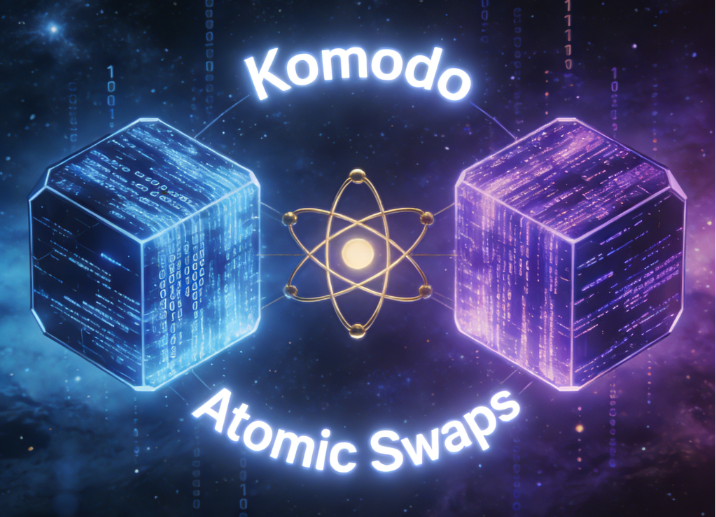
An atomic swap is a technology that enables the peer-to-peer (P2P) exchange of cryptocurrencies between two different blockchains without a trusted third party. The term "atomic" means the swap either completes successfully, with both parties receiving their funds, or it fails entirely, with both parties retaining their original funds. It is an all-or-nothing transaction.
How Atomic Swaps Work: A Step-by-Step Guide
Komodo’s technology uses a type of smart contract called Hashed Time-Locked Contracts (HTLCs) to facilitate these swaps. Let's break it down with a simple example.
Imagine Trader A in Ho Chi Minh City wants to trade her Bitcoin (BTC) for Trader B's Komodo (KMD) in Hanoi.
- Agreement: Trader A and Trader B agree on an exchange rate (e.g., 1 BTC for 5,000 KMD).
- Trader A's Action: Trader A creates a "contract" on the Bitcoin blockchain. This contract locks up her 1 BTC and generates a secret key (a random number). She then sends the hash of this secret key to Trader B. A hash is a one-way cryptographic function; you can't reverse it to find the original secret.
- Trader B's Action: Trader B creates a similar contract on the Komodo blockchain, locking up his 5,000 KMD. This contract requires the same secret key that Trader A created to unlock the funds.
- The Swap:
- Trader A unlocks and claims the 5,000 KMD from Trader B's contract by revealing her secret key.
- When she does this, the secret key becomes public on the Komodo blockchain.
- Trader B sees the secret key and uses it to unlock and claim the 1 BTC from Trader A's contract.
- The Time-Lock: Both contracts have a time limit. If the swap is not completed within a set timeframe (e.g., 24 hours), the contracts expire, and the funds are automatically returned to their original owners. This prevents one party from holding the other's funds hostage.
The result is a secure, trustless trade. Neither trader ever had to send their funds to an intermediary. The entire process is managed by cryptographic proofs.
Part 4: Why Komodo Atomic Swaps are a Game-Changer for Vietnam
The Vietnamese crypto market is one of the most active in the world. As adoption grows, so does the need for secure and sovereign trading solutions.
1. Unprecedented Security and Control
The biggest advantage is security. With atomic swaps, your private keys never leave your possession. You are always in full control of your assets. This eliminates the risk of exchange hacks, which have cost investors billions of dollars globally. For Vietnamese investors who prioritize asset security, this is a revolutionary feature.
2. Access to Wider Liquidity
Centralized exchanges list a limited number of trading pairs. If you want to trade two less common coins, you often have to perform multiple trades (e.g., Token A -> USDT -> Token B), incurring multiple fees.
- Komodo's Advantage: Komodo's AtomicDEX, a decentralized exchange powered by atomic swaps, supports over 99% of all cryptocurrencies. This allows you to trade virtually any coin directly for another, opening up a universe of trading pairs that are unavailable on most centralized platforms.
3. Cost-Effective Trading
While the swap itself is peer-to-peer, there is a very small fee (0.15%) paid to the network. This is often significantly lower than the trading fees charged by major centralized exchanges, especially for large volume traders.
4. Privacy and Anonymity
Atomic swaps do not require you to create an account or submit personal information (KYC). Your trades are conducted directly on the blockchain, providing a level of privacy that centralized platforms cannot match.
Part 5: Your Entry Point to Secure Trading
While atomic swap technology is powerful, you still need a reliable on-ramp to acquire your initial assets. This is where a secure and user-friendly platform is crucial for Vietnamese users.
Step 1: Choose a Trusted Platform
To start your journey, select a platform that understands the local market and prioritizes your security. HIBT offers a comprehensive trading experience designed for both beginners and seasoned investors in Vietnam.
Why Start with HIBT?
- Localized for Your Ease: The entire platform, from the interface to customer support, is available in Vietnamese.
- Secure Your Future: With multi-layer security and robust asset protection, you can invest with peace of mind.
- Seamless On-Ramp: Easily deposit Vietnamese Dong (VND) through local payment methods to buy your first crypto assets like Bitcoin, Ethereum, or Komodo.
Step 2: Register Your Account
- Visit the HIBT website or download the mobile app.
- Complete the registration process.
- Activate Two-Factor Authentication (2FA) for an added layer of account security.
Step 3: Fund and Acquire Assets
Once your account is set up, deposit funds and navigate to the trading pairs (e.g., KMD/USDT). You can then acquire the assets you wish to trade via atomic swaps or hold them as part of your investment portfolio. Platforms like HIBT are your secure gateway to the broader world of decentralized finance.
Part 6: Komodo's AtomicDEX - The Technology in Action
Komodo didn't just pioneer the theory of atomic swaps; they built a powerful application to showcase it: AtomicDEX.
AtomicDEX is a non-custodial wallet and decentralized exchange (DEX) rolled into one. It is the world's most advanced implementation of atomic swap technology.
Key Features of AtomicDEX:
- Massive Interoperability: It supports swaps between Bitcoin-protocol coins (like BTC, LTC, DOGE) and Ethereum-protocol tokens (ERC-20 tokens), bridging the two largest crypto ecosystems.
- Hybrid Order Book: Unlike many DEXs that rely solely on automated market makers (AMMs), AtomicDEX uses a peer-to-peer order book. This allows for limit orders and provides a trading experience familiar to those who use centralized exchanges.
- Mobile-First Design: AtomicDEX is available as a desktop and mobile application, allowing you to perform secure, trustless trades from anywhere.
Case Study: A Freelancer's Cross-Border Payment
Consider a Vietnamese freelance developer, Linh, who completes a project for a client in Europe. The client wants to pay her in Ethereum (ETH), but Linh prefers to hold Bitcoin (BTC) for long-term savings.
- The Old Way: Linh would receive ETH on a centralized exchange, sell it for USDT, then use the USDT to buy BTC. This involves two trades, two sets of fees, and trusting the exchange with her funds.
- The Atomic Swap Way: Linh and her client can use a platform like AtomicDEX. The client initiates an atomic swap of his ETH for Linh's BTC (or a stablecoin she holds). The trade happens directly between their wallets. Linh receives BTC securely and with minimal cost, without ever giving up custody of her funds.
Part 7: Risks and Considerations of Atomic Swaps
While revolutionary, atomic swap technology has its own set of considerations.
- Liquidity: For a swap to occur, there must be another person on the other side of the trade. While AtomicDEX's network is growing, its liquidity for some pairs may not yet match that of the largest centralized exchanges.
- User Experience: The technology is more complex than a simple CEX trade. While applications like AtomicDEX have made it much more user-friendly, it still requires a greater degree of technical understanding from the user.
- Transaction Times: The speed of an atomic swap is dependent on the confirmation times of the two blockchains involved. A swap involving Bitcoin will inherently be slower than a swap between two faster chains.
Investor Strategy: Atomic swaps are an incredibly powerful tool for security-conscious investors. They are ideal for large trades where counterparty risk is a major concern, or for accessing exotic trading pairs not available elsewhere. For day-to-day trading and quick access to liquidity, a hybrid approach using both trusted centralized platforms and decentralized tools is often the most practical strategy.
Part 8: The Broader Komodo Ecosystem
Komodo's vision extends far beyond atomic swaps. The platform offers a full suite of tools for building sovereign, interoperable blockchains. One of its most important features is delayed Proof-of-Work (dPoW).
dPoW: Bitcoin-Level Security for Any Blockchain
dPoW is a security mechanism that allows other blockchains to "notarize" their transaction records onto the Bitcoin ledger. By doing this, any attempt to attack the smaller chain would also require attacking the massively powerful Bitcoin network, making it economically unfeasible.
This means a project can launch its own independent Smart Chain on Komodo, enjoy full customizability, and still benefit from the highest level of security in the entire industry. This combination of independence and security is unparalleled.
Conclusion: Take Control of Your Trades
The evolution of cryptocurrency is a journey toward true decentralization. Komodo Atomic Swaps represent a monumental step on that path. They remove the need to trust a third party, placing the power and security of trading directly back into your hands. This technology moves the industry away from centralized points of failure and toward a more resilient, sovereign, and peer-to-peer financial future.
For the savvy Vietnamese investor, atomic swaps are not just a novelty; they are an essential tool for risk management and financial empowerment. They provide a secure way to diversify your portfolio, access a broader market, and protect your assets from the inherent risks of custodial platforms.
The future of trading is decentralized. Empower your investments by embracing the tools that give you control.
To begin your journey and acquire the assets needed to participate in this revolution, start with a platform built on trust and security. Register your account on HIBT today and unlock your gateway to the digital asset economy.
About the Author
Dr. Ivan Volkov
PhD in Distributed Consensus, Chief Security Auditor for Halcyon Labs
Dr. Ivan Volkov is a leading expert in cross-chain communication and decentralized exchange technology. He holds a PhD in Distributed Consensus and has published over 18 peer-reviewed articles on topics including atomic swaps and blockchain interoperability. Dr. Volkov has led the technical and security audits for several prominent DeFi and cross-chain bridge projects, ensuring the integrity and safety of billions of dollars in user assets. His work is focused on building a truly trustless and interconnected multi-chain ecosystem.